
Standard Response Protocols
PPA FOLLOWS STANDARD RESPONSE PROTOCOL (SRP)
A critical ingredient in the safe school recipe is the uniform classroom response to any incident. Weather events, fires, accidents, intruders, and other threats to student safety are scenarios that are planned and trained for by school and district administration and staff. Historically, schools have taken this scenario-based approach to respond to hazards and threats.
SRP IS ACTION-BASED
The Standard Response Protocol (SRP) is based not on individual scenarios but on the response to any given situation. Like the Incident Command System (ICS), SRP demands a specific vocabulary but also allows for great flexibility.
The Standard Response Protocol (SRP) is based not on individual scenarios but on the response to any given situation. Like the Incident Command System (ICS), SRP demands a specific vocabulary but also allows for great flexibility.
To assist site administrators, Douglas County School District utilizes a system called Standard Response Protocol (SRP) to guide administrators, staff, classrooms, and individual students through standardized responses regardless of the threat. This all-hazards approach focuses not on the incident itself, but rather on the required response by those involved. The SRP provides five simple concise actions to be taken regardless of whether a tornado has been spotted nearby or criminal activity has been reported or a wildfire is on the horizon. Instead of initiating different actions for each scenario, the SRP utilizes the five actions for all potential threats.
 HOLD
Action: Hold in your room or area. Clear the halls.
Hold is called when the hallways need to be kept clear, even during class changes.
Holds can be called due to a variety of reasons ranging from large water spill to an individual medical emergency. A Hold means students will remain in their current classroom until the hold is released. They will continue class as normal.
PPA does not normally communicate to families when a Hold is called. There is no threat to students or staff. Holds may be called due to individual medical emergencies - this means PPA is not allowed to release any information regarding the reason for the Hold in order to protect the individual's privacy.
 SECURE
Action: Get inside. Lock outside doors.
If there is a threat outside the building, bring everyone in and lock the outside doors. Secure is called by district or site administrator. Secure can be called when staff or students notice something weird or strange. Secure could be the response to a violent person or incident in the community near your school. Teachers, staff or administration will get students back into the building. Teachers will take roll and notify the office of missing or extra students. This means an increased situational awareness, but class will be conducted as usual.
PPA will communicate a call for a Secure to families if the call was made due to a dangerous situation in the area of the school.
Sometimes, secures may be called due to wild life located close to the building, this is called out of extreme caution but does not represent an immediate danger - this type of situation may not be communicated to families.
LOCKDOWN
Action: Locks, Lights, Out of Sight
Lockdown is the protocol used to secure individual rooms and keep students quiet and in place. Teachers will lock classroom doors and turn lights out. In addition, teachers and students will move away from corridor line of sight and maintain silence. The teacher will take roll and account for all students. Occupants of rooms will not unlock their rooms for anything or anyone. When the incident is over, a responsible person capable of unlocking the room from out in the hall (administrator, custodian, Law Enforcement, etc) will unlock the door and brief the occupants.
In the case of a Lockdown, families will be notified as soon as possible.
 EVACUATE
Action: Follow the Directions
Evacuate means moving students in an orderly fashion from point A to point B. A fire drill is really: “Evacuate Out of the Building.” With the SRP, Evacuate is always followed by a location. For instance: Evacuate to the Gym. The order to evacuate will always be followed by a location. Administrators, teachers, and building staff all need to work together to quickly, quietly, and safely evacuate students to the evacuation point. Students and staff will leave stuff (backpacks, books, etc) behind. Instructions detailing specific actions during the evacuation may take place such as holding hands, covering heads, and/or crawling. Teachers will ensure they bring a roll sheet. Immediately upon reaching the evacuation point, teachers should take roll.
In the case of an Evacuate, families will be notified as soon as possible.
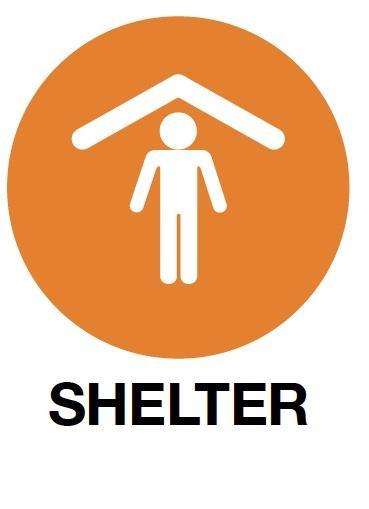 SHELTER
Action: Follow the Directions
This action is similar to “shelter in place”, however the SRP gives specific instructions within the action. For example instead of just announcing shelter, the command may be “Shelter for tornado, drop cover and hold”. The command will be to shelter, what we are sheltering from, and the specific self protection action to do.
Teachers will ensure they have all of their students by taking roll.
In the case of a Shelter, families will be notified as soon as possible.